
For Aged Care Providers
Most Families Are Unprepared When a Crisis Occurs.
Critical Info helps aged care providers engage clients, families and substitute decision-makers earlier — improving preparedness, reducing crisis-driven decision-making and supporting alignment with the Strengthened Aged Care Quality Standards and the Aged Care Act 2024.
- Support end-of-life planning earlier
- Improve family preparedness
- Reduce crisis-driven decision-making
- Strengthen workforce confidence
- Support Outcome 5.7 implementation
- Demonstrate proactive person-centred care

Pilot Partners
- Melville Cares
- Western Suburbs Cares
- Sustainable Funerals Group
- Good Death Impact Network
Context
Why Providers Are Looking at Preparedness Now
Aged care providers are operating in an environment of:
- Strengthened Aged Care Quality Standards
- Aged Care Act 2024 reforms
- Support at Home transition
- Workforce shortages
- Increased psychosocial risk obligations
- Greater expectations around end-of-life support
Most providers already deliver compassionate care. The challenge is demonstrating that clients, families and supporters were prepared before a crisis occurred.
Critical Info helps providers create a structured preparedness pathway that sits alongside existing care planning and end-of-life processes.
The Challenge
The Gap Between Good Intentions and Demonstrable Preparedness
Most aged care providers already deliver compassionate, person-centred care. The challenge is not whether support exists. The challenge is whether clients, families, supporters and substitute decision-makers are prepared before a crisis occurs.
Providers consistently report that clients often experience significant health decline, hospitalisation or end-of-life without clearly documented wishes, identified decision-makers, organised information or a shared family understanding of what matters most.
When this occurs, staff are required to navigate highly emotional situations while simultaneously supporting care delivery, family communication and service coordination.
This creates:
- Reactive decision-making
- Family conflict
- Increased workforce pressure
- Delayed planning conversations
- Greater emotional burden on staff
- Difficulty demonstrating proactive end-of-life support
The Solution
The Critical Info Embedded End-of-Life Preparedness Program
Critical Info provides a structured preparedness program embedded within existing aged care pathways. The program supports clients, families, supporters and substitute decision-makers to organise important information, identify decision-makers, document wishes and access trusted guidance before a crisis occurs.
Stage 1
1Onboarding and Early Engagement
Introduce preparedness early and help people identify what they know, what they don't know and what still needs to be put in place.
Stage 2
2Decline and Increasing Care Needs
Review wishes, documentation, decision-makers and support networks as circumstances change.
Stage 3
3End-of-Life and Bereavement
Provide practical guidance, family support, navigation resources and bereavement assistance.
Supporting Outcome 5.7
Supporting Outcome 5.7: End-of-Life Planning
Critical Info supports providers to operationalise and evidence activities associated with Outcome 5.7 of the Strengthened Aged Care Quality Standards.
Earlier planning conversations
Guided preparedness pathway
Family engagement
Structured family conversations
ACP readiness
Decision-maker identification and prompts
Documentation awareness
Location of key documents recorded
Bereavement support
National After-Death Guide and Resource Hub
Preparedness education
Platform, workshops, podcast and live support
Critical Info supports providers to evidence preparedness activities. Responsibility for compliance remains with the provider.
Broader Standards Alignment
Supporting Outcomes Across the Strengthened Standards
The program's impact extends beyond Outcome 5.7, supporting evidence and practice across multiple outcomes of the Strengthened Aged Care Quality Standards.
- 3.1
Assessment and planning
Clients arrive with wishes, contacts, document locations and cultural preferences already documented — reducing intake burden and enriching care planning from day one.
- 5.6
Cognitive impairment
Helps individuals and families capture wishes, preferences and decision-makers while capacity is strong — before cognitive decline progresses.
- 5.7
Palliative and end-of-life care
Supports preparation, ongoing planning and bereavement across the full end-of-life journey.
- 7.2
Transitions
Reduces information loss at transitions of care; families and receiving services have access to current, organised information.
Workforce Wellbeing
Better Prepared Families Mean Less Pressure on Staff
When families are unprepared, staff often carry the burden of:
Critical Info helps move these conversations earlier, creating better prepared clients, families and decision-makers before a crisis occurs. This may help reduce avoidable workforce pressure while supporting psychosocial health and safety initiatives.
- Repeated difficult conversations
- Family conflict
- Decision uncertainty
- Crisis coordination
- Emotional escalation
What Providers Receive
Outcomes that strengthen your client journey.
Client Preparedness
Help clients organise information, identify decision-makers and document wishes before a crisis occurs.
Family Preparedness
Support families to understand preferences, reduce uncertainty and make informed decisions.
Workforce Confidence
Provide practical tools and resources that help staff navigate difficult conversations.
Quality Standards Alignment
Strengthen evidence of preparedness, engagement and person-centred decision-making.
Reduced Crisis Management
Support earlier conversations and reduce reactive decision-making.
Continuous Improvement
Generate meaningful reporting and insights for accreditation and quality improvement.
Optional Program Enhancements
Extend the program to suit your organisation.
Workforce Preparedness & Capability
Grief literacy, end-of-life communication skills, psychosocial hazard awareness and volunteer capability development.
Community Education & Engagement
Community talks, client and family workshops, and Bring-a-Loved-One sessions.
Campaign & Audience Growth Support
Localised awareness campaigns and family engagement activities.
Enterprise Integration & Customisation
Multi-site implementation, custom reporting, co-branded resources and workflow integration.
Proven Impact
Proven Behaviour Change Outcomes
When aged care organisations provide structured opportunities for preparedness conversations, people engage.
90%
Took practical planning actions
Helping people move beyond intention and into action.
80%
Updated important legal, personal or administrative documents
Improving preparedness and reducing information gaps.
70%
Started conversations with family or decision-makers
Creating better alignment before a crisis occurs.
78%
Reported planning felt easier
Reducing overwhelm and uncertainty.
60%
Reported confidence discussing end-of-life wishes
Supporting more informed decision-making.
From the national end-of-life doulas pilot, conducted in partnership with the Good Death Impact Network and Sustainable Funerals Group.
WA community aged care pilot — Melville Cares & Western Suburbs Cares
Engagement across clients, families and care teams.
- 100+ participants attended community education activities
- Earlier preparedness conversations initiated
- Increased referrals into end-of-life pathways
- Strong engagement from clients, carers and families
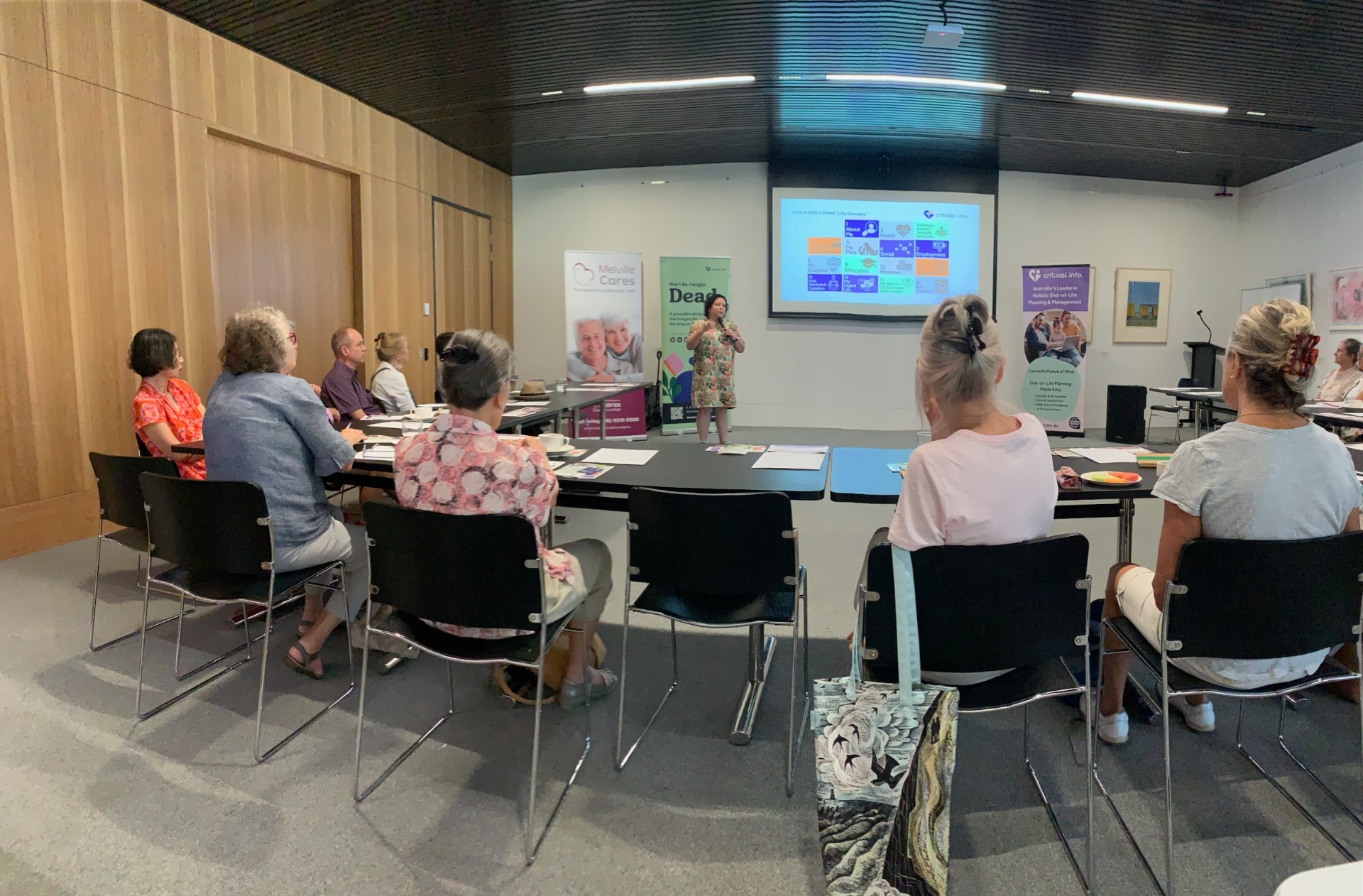
Catherine Ashton presenting Critical Info to community participants.
WA Pilot Partner
“We’re proud to be the first aged care provider in Australia to adopt the Critical Info Platform, helping clients and their families live more aligned with their values and preferences.”
“We know that a major barrier has been early planning of what we want at end of life, but our partnership with Critical Info has provided us with a vehicle that is practical and guides the process in a simple and effective way.”
Maria Davison
CEO, Melville Cares & Western Suburbs Cares
Social Proof
Trusted and Supported By
Pilot Partners
- Melville Cares
- Western Suburbs Cares
Supporters
- Sustainable Funerals Group
- Good Death Impact Network
- Griefline
Community Collaborators
- Australian Funeral Directors Association
- Australian Home Funeral Alliance
The Critical Info Ecosystem
A preparedness ecosystem, not just a platform.
The platform is one component of a broader preparedness ecosystem supporting clients, families, supporters and care teams across the entire journey.
Embedded program
End-of-Life Preparedness Ecosystem
Critical Info Platform
My loved one has died, what do I do now? — National After-Death Guide
Resource Hub
Critical Chat Tuesdays
Critical Planning Hour
Don't Be Caught Dead Podcast
Education & Training
Reporting & Insights

Founder Story
Why Catherine Created Critical Info
In 2019, Catherine survived a serious accident that forced her to confront how little of her own life was documented or organised. The experience of navigating personal preparedness — while recovering — left a lasting impression.
In 2023, the sudden death of a close friend brought that experience into sharper focus. Catherine watched the family struggle to locate basic information: accounts, wishes, decision-makers, even the smallest practical details that compound grief at the worst possible time.
Critical Info was created to change that — to help individuals, families and the organisations who support them prepare earlier, reduce distress and bring structure to the conversations that matter most.
Catherine Ashton
Founder & CEO, Critical Info
Low-Risk Entry Point
Why Start With a Pilot?
The 90-day Embedded End-of-Life Preparedness Pilot allows providers to validate the approach before considering broader implementation.
- 1Test engagement
- 2Assess family participation
- 3Evaluate preparedness outcomes
- 4Explore workforce impacts
- 5Review integration opportunities
- 6Build internal stakeholder support
Privacy & Security
Your Organisation Holds Zero Resident Data
Critical Info is designed so that providers carry no additional data risk. Sensitive documents stay with the client and their chosen decision-makers.
- No wills uploaded
- No powers of attorney uploaded
- No identity documents uploaded
- No document repository to breach
- No chain-of-custody obligations
- Australian-hosted
- ISO 27001 certified
- ISO 9001 certified
Executive Summary
The Problem We Solve
Most aged care providers already have an End-of-Life Pathway.
The challenge is that clients and families often enter that pathway too late and unprepared.
Critical Info helps engage people earlier through a structured preparedness ecosystem that supports clients, families, supporters and substitute decision-makers before a crisis occurs.
The result is better preparedness, improved family engagement and stronger evidence of proactive end-of-life support.
Next step
Explore Whether Critical Info Fits Your Existing End-of-Life Pathway
Book a 30-minute discussion to explore:
- Your current pathway
- Family preparedness challenges
- Workforce impacts
- Outcome 5.7 opportunities
- Potential pilot implementation
No obligation.